Caring for a parent from abroad
Living in a different country from your parents? Practical ways to stay involved, from a local support network and paperwork to daily signs that all is well.
On this page
Living in a different country from your parents brings a particular kind of worry. You can't pop round. A missed call at an odd hour makes your stomach drop. And you often hear about problems weeks after they happen, usually from a neighbour.
You can't be there every day, but you can still be closely involved. The families who manage it best tend to do three things: build a small support network near their parents, sort out the practical paperwork before it's urgent, and set up a few gentle daily signals that all is well, so silence stops being scary.
This guide covers each, with ideas that work whether your parents are in Rome, Lagos, Manila or Manchester.
Caring from a distance still counts
Many people living abroad don't think of themselves as carers. They're "just keeping an eye on Mum". But organising appointments, chasing prescriptions and worrying at 2am is caring, and recognising it helps you ask for support.
Carers First, a carers' charity, suggests naming the role, building a support network, setting boundaries, and protecting your own wellbeing, including time when you're not on standby.
Build a support network near your parents
You can't be there, so make sure someone can. A small network of people who would notice, and could help, makes the biggest difference.
| Who | What they can do | What to agree |
|---|---|---|
| A neighbour | Notice if curtains stay closed or post piles up; hold a spare key | Your number, and when to call you |
| A local friend or relative | Pop round, go to appointments, help in a crisis | How often they visit; what they'd like help with |
| Their GP surgery | Medical care, reviews, referrals | Whether your parent is happy for them to speak to you |
| Their pharmacy | Prescriptions, deliveries, medicine reviews | Delivery details; who collects |
| Local services | Help at home, meals, transport, social groups | What's available where they live |
Write it all down in one place (names, numbers, addresses) and share it with siblings and with your parents. It's the document you'll be glad of at 2am.
Sort out the paperwork early
The hardest crises are the ones where nobody has permission to act. While your parents are well, talk about:
- Who can speak to the doctor. Many surgeries will speak to family only with the patient's consent. Ask your parent to record it.
- Who can help with money. A trusted person added to accounts, or the bank's own arrangements for a helper.
- Decision-making if they couldn't decide for themselves. In England and Wales, this is a lasting power of attorney.
According to GOV.UK, a lasting power of attorney lets someone (the donor) name people to make decisions for them if they can't, either about health and welfare or about property and finances. The donor doesn't have to live in the UK, but an LPA is legally binding only in England and Wales. If your parents live in another country, ask a local lawyer or notary about the equivalent there.
Daily signals instead of daily calls
When you live far away, silence becomes the problem. A day without news feels like a day something might have gone wrong. Daily calls can fix that, but they're hard to keep up across time zones, and they can start to feel like checking up for both of you.
A better approach: a few small, regular signals that tell you all is well, so calls can go back to being conversations.
A reminder they tap Done on
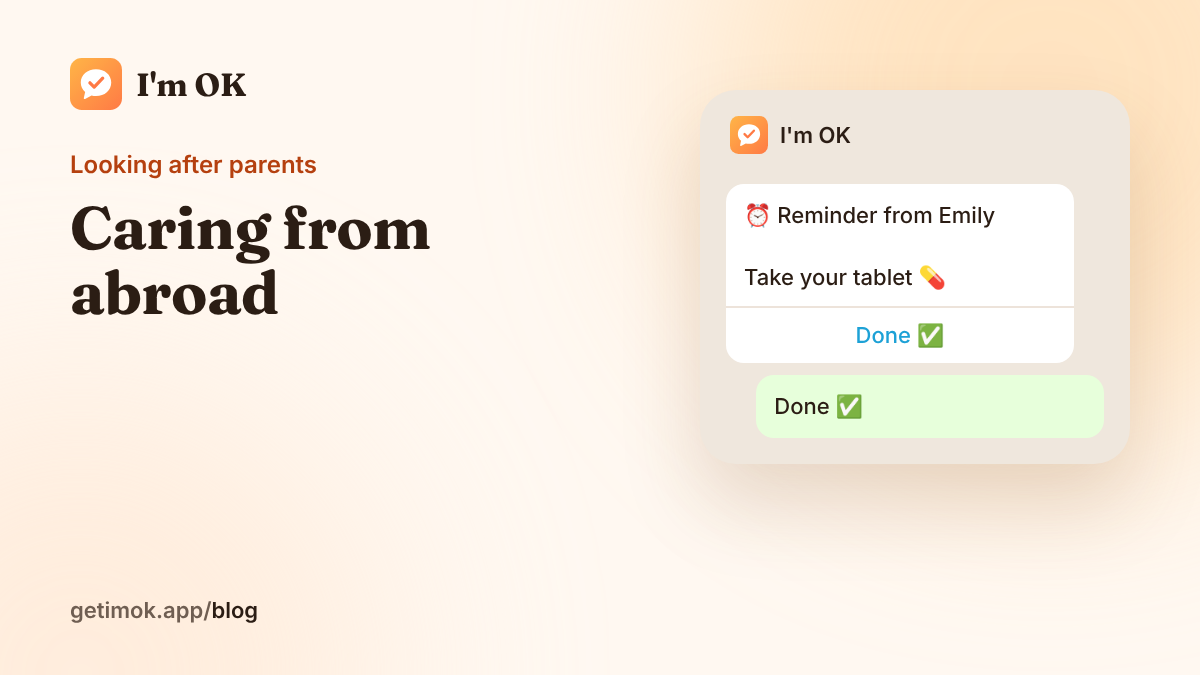
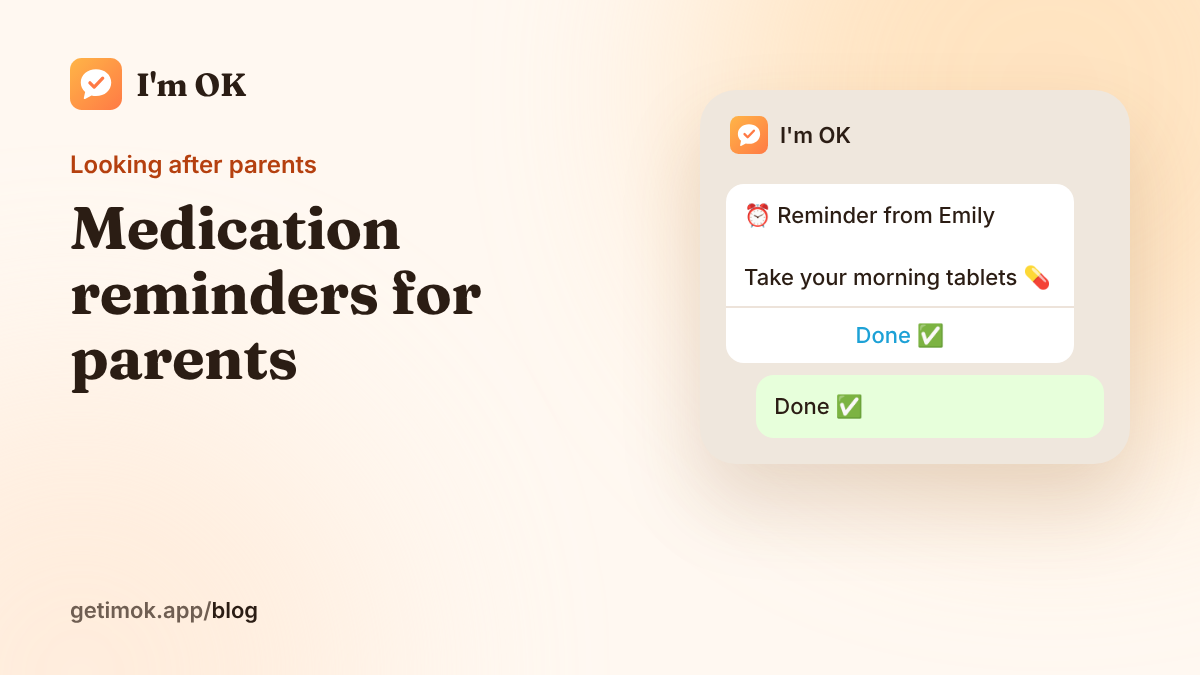
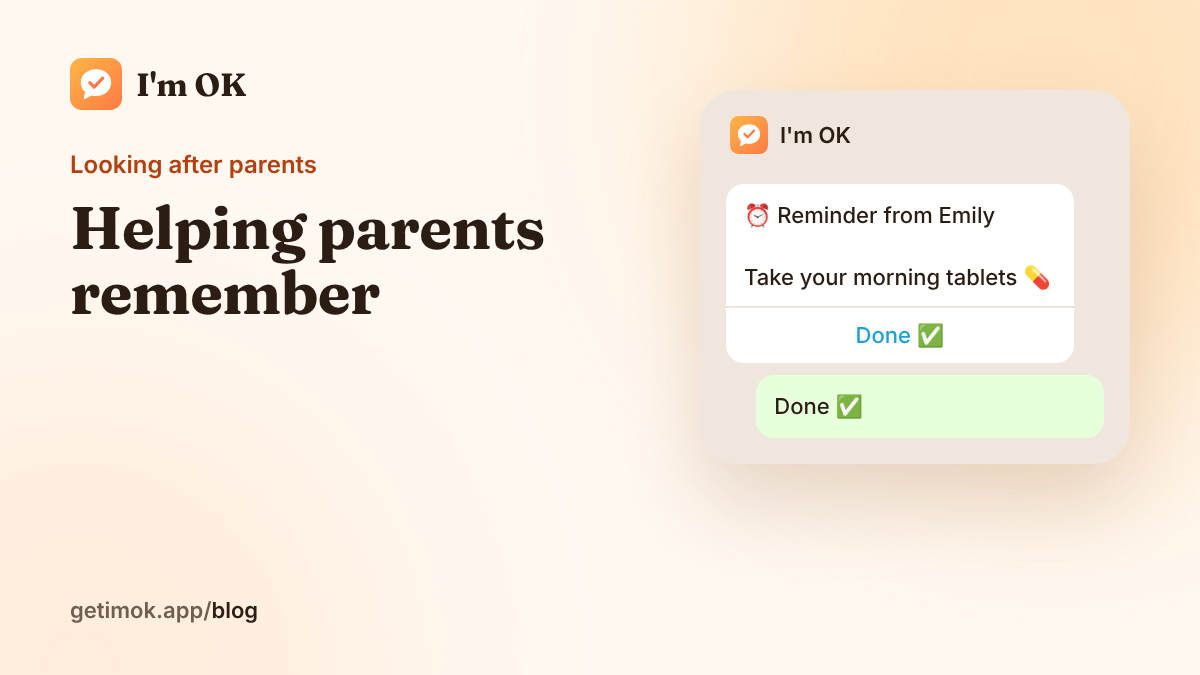
Their morning tablets, for example. When they tap Done, you can see it, from anywhere. If they don't, you hear about it.
A daily check-in
One message a day that they answer with one tap. If they don't, you (or someone nearby) are told.
A shared routine
A call every Sunday at the same time. Predictable, and something to look forward to.
Photos and voice notes
The family group chat, used for life rather than logistics. Hearing their voice tells you a lot.
How I'm OK helps
I'm OK sends reminders on WhatsApp, which many parents abroad already use to keep in touch with family. You set a reminder in one message, for example "remind Mum every day at 9 to take her tablets". Mum says yes once, then gets it every day at 9am, her time, with a Done button. You see it's done on your page, wherever you are. If she doesn't tap it, you're told, so you can give her a ring.
There's also the daily I'm OK: one message a day that your parent answers with a tap. If they don't, the people you chose are told. It's free, and works across countries. Our guide to helping an ageing parent remember the important things has more on routines that work well at a distance.
Time zones without the confusion
- Set reminders in their time. A tablet at 9am should mean 9am where they are, not where you are.
- Agree a "call window". A regular time that suits both time zones, so calls don't land at 6am or midnight.
- Know when the clocks change. Different countries change clocks on different dates (and some don't change at all), so the gap between you may shift twice a year.
Medicines from afar
Medicines are one of the biggest worries, and one of the easiest to help with remotely. The NHS tips for carers suggest ordering repeat prescriptions in good time, using a pharmacy delivery service where available, and considering pill organisers or reminders. Many of these have equivalents abroad.
Our guide on how to remind an elderly parent to take their medication goes into this in more detail.
Make visits count
When you do visit, use the time for what can't be done remotely:
- Go to an appointment with them, with their agreement.
- Meet the neighbour or friend who keeps an eye on them, and thank them.
- Check the house: smoke alarms, loose rugs, lighting on the stairs.
- Update your contacts document.
- And most of all, spend time together that isn't about caring at all.
Look after yourself too
Worrying from a distance is exhausting, and it often comes with guilt about not being there. You're doing more than you think. Share the load with siblings where you can, agree what you can realistically do, and take time off from being on standby. A good support network around your parents is also a support network for you.
Questions people ask
How can I look after my elderly parents from abroad?
Build a small support network near them (a neighbour, a local friend, their GP and pharmacy), sort out paperwork early, and set up simple daily signals that all is well, so you don't rely on daily calls.
How do I know my parent is OK if I live in another country?
Use small daily signals: a reminder they tap Done on, or a one-tap daily check-in. With I'm OK, you see when it's done from anywhere, and you're told if it isn't.
Can I set reminders for my parent in their time zone?
Yes. I'm OK reminders follow the local time of the person receiving them, so a 9am reminder arrives at 9am where your parent is.
Does a lasting power of attorney work abroad?
A UK lasting power of attorney is legally binding only in England and Wales. If your parents live elsewhere, ask a local lawyer or notary about the equivalent in that country.
How often should I call my parents if I live abroad?
There's no right answer. Many families find a regular, predictable call works better than lots of short check-up calls, with daily signals covering the rest.
Keep reading
How to remind an elderly parent to take their medication
Practical ways to help a parent remember their tablets, from pill organisers and pharmacy help to reminders they can answer, without taking over.
How to help an ageing parent remember the important things
Tablets, appointments, bin day and bills. Practical ways to help a parent remember what matters, without taking over their life or calling all day.
What is a safety word, and how do you use one?
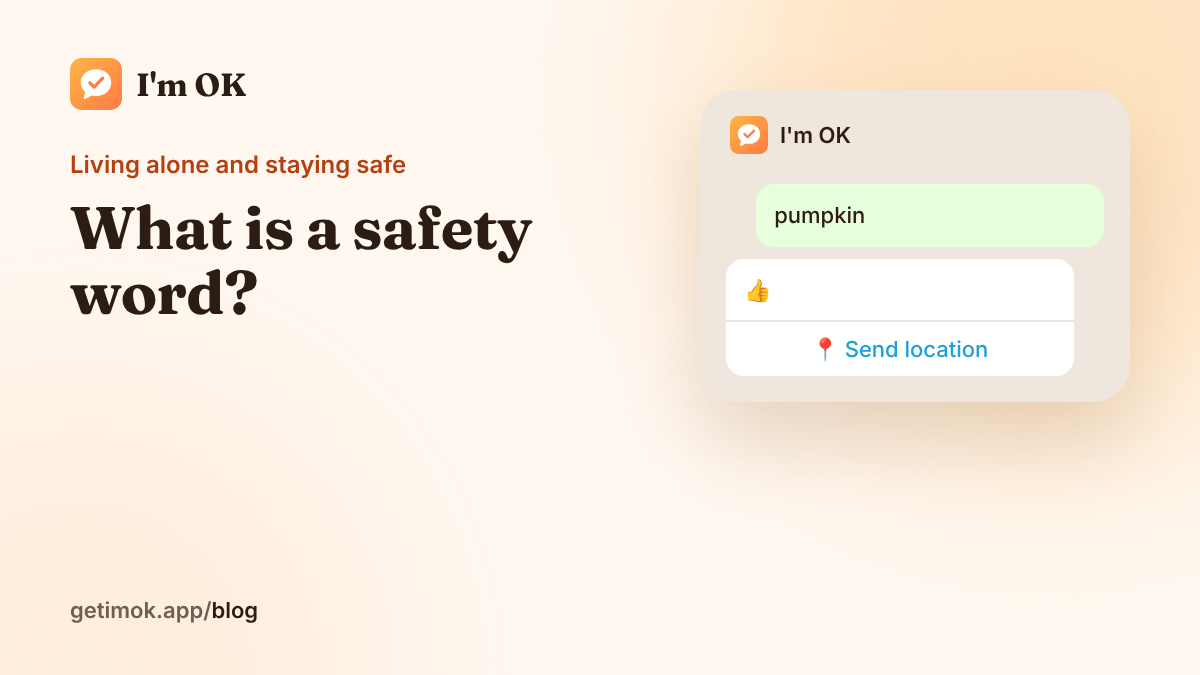
A safety word is a secret word that tells the people you trust you need help, without anyone else knowing. How it works, when to use one, and how to set one up.