How to remind an elderly parent to take their medication
Practical ways to help a parent remember their tablets, from pill organisers and pharmacy help to reminders they can answer, without taking over.
On this page
If your mum or dad has started missing tablets, or you're not sure whether they've taken them, you're not alone. It's one of the most common worries for anyone looking after an older parent, and one of the easiest to make better.
The short answer: make the tablets easy to see and sort, tie them to something your parent already does every day, and add a reminder they can answer, so you know it's done without having to ask.
This guide goes through what helps, in the order most families try it, and how to do it in a way that keeps your parent in charge.
Why older parents miss their tablets
It's rarely just "forgetting". More often it's a mix of small things:
- The routine is complicated. Several tablets, at different times, some with food and some without.
- The day has no fixed shape any more. Without work or school runs, one morning blurs into the next.
- They can't tell whether they've already taken them. This is the big one, and it can lead to doubling up as well as missing doses.
- Eyesight and fiddly packaging. Small print and stiff blister packs don't help.
- They don't feel the point. Some medicines (blood pressure tablets, for example) don't make anyone feel different day to day, so they slip.
Knowing which of these is going on tells you what to fix. If the problem is "did I take it?", a pill organiser helps most. If it's "I lose track of the time", a reminder helps most.
Start with a conversation, not a system
Before you buy anything or set anything up, talk to your parent. Ask how they find their tablets, whether any are a nuisance, and what would help. People are far more likely to stick with a routine they chose.
A few things that tend to help the conversation:
- Make it about the tablets, not about them. "These new ones are a faff, aren't they?" lands better than "You keep forgetting."
- Offer, don't impose. "Would it help if...?" keeps them in charge.
- Agree what you'll know. Some parents are happy for you to see when they've taken their tablets. Some would rather not. Ask.
Ask the pharmacist for help
The pharmacist is the most underused person in this whole problem. The NHS medicines tips for carers suggest a few things worth asking about:
- A structured medication review. The GP surgery may offer a free review with a pharmacist. It's a good moment to ask whether the routine can be simpler, for example fewer doses a day. Go along with your parent if they'd like you there.
- Compliance aids. A pharmacist may be able to supply tablets in organisers with labelled compartments for each day and time. These aren't always free on the NHS, so ask.
- Repeat prescriptions. Ask the GP to send prescriptions straight to the pharmacy, and check whether the pharmacy delivers. Running out is a common reason for missed doses.
Make the tablets easy to see and sort
A visible system solves the "did I already take it?" problem on its own.
Weekly pill organiser
A box with a compartment for each day (and morning or evening). If Tuesday's lid is shut, Tuesday's tablets haven't gone. Cheap and easy to fill once a week.
Pharmacy packs
Tablets packed by the pharmacy into labelled sections for each dose. Less filling for you, but ask whether your pharmacy offers it and whether there's a charge.
Automatic dispenser
A locked device that opens the right compartment at the right time and beeps. Useful for complex routines, though some people find them fiddly.
A simple chart
A tick sheet on the fridge next to the tablets. Low tech, and surprisingly effective for people who like to see their progress.
Keep everything in one place, ideally where the tablets will be taken (by the kettle, or next to the toothbrush) and out of reach of visiting grandchildren.
Tie the tablets to something they already do
Habits stick when they piggyback on existing ones. Instead of "take at 9am", try:
- "With your first cup of tea."
- "Before you open the curtains."
- "When the evening news starts."
Put the organiser where that habit happens. A reminder then becomes a nudge to do something they're already about to do, rather than an interruption.
Reminders that actually work
Reminders help most when the routine is set but the timing slips. There are a few ways to do it:
| Option | Good for | Watch out for |
|---|---|---|
| Phone alarm on their phone | Parents comfortable with their phone | Easy to dismiss; nobody knows if the tablet was taken |
| A daily call from you | Connection as well as a reminder | Hard to keep up every day; can start to feel like checking up |
| Smart speaker reminder | Parents with a speaker at home | Only reminds; no way for you to know it's done |
| A reminder they answer on WhatsApp | Parents who already use WhatsApp | Needs them to tap Done |
The difference that matters is the last column. A reminder that only reminds leaves you wondering. A reminder your parent can answer, with one tap, tells you it's done, so you don't need to ring and ask "have you taken your tablets?" (which no one enjoys, on either end).
What a good reminder looks like
- It arrives where they already look. For many parents that's WhatsApp, which they use to chat with the grandchildren.
- It's short. "Take your morning tablets 💊" is better than a paragraph.
- It says who it's from. "Reminder from Emily" feels caring; an anonymous beep feels like nagging.
- Answering takes one tap. If they have to type a reply, many won't.
- If it's missed, someone knows. Not straight away, and not with a fuss, but in time to give them a ring.
How I'm OK helps
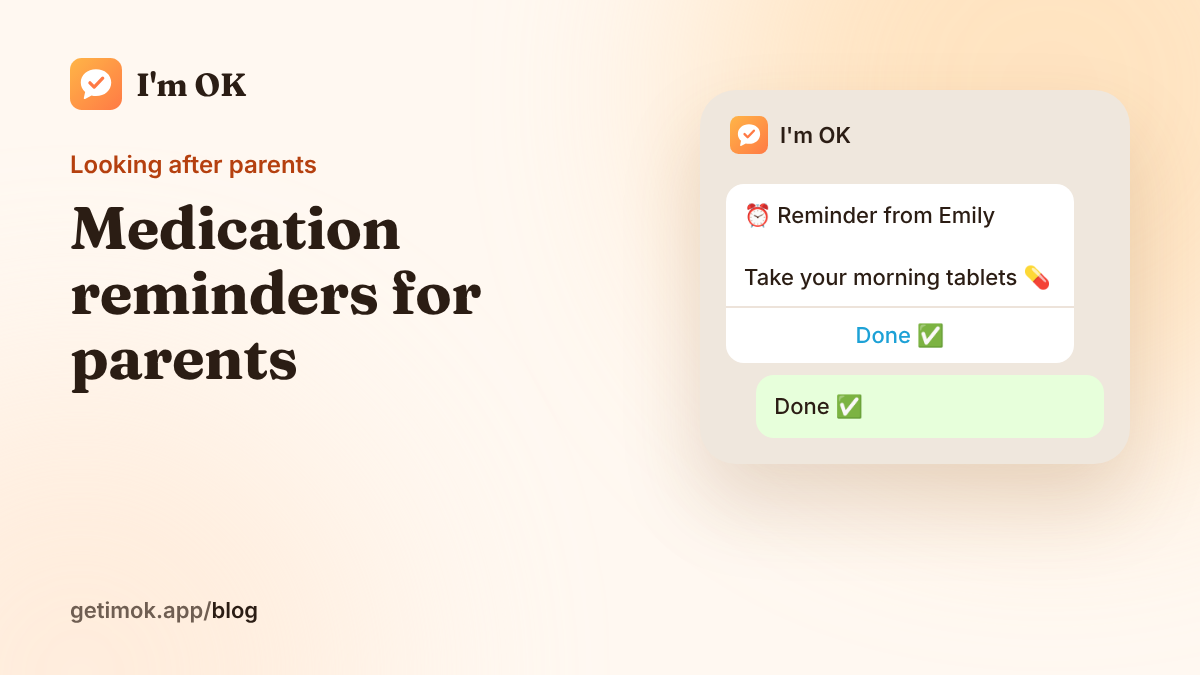
I'm OK is a reminder service that works inside WhatsApp, so there's no app for you or your parent to install. You tell it, in one message, who to remind, what and when, for example "remind Mum every day at 9 to take her tablets". Your mum gets one message first asking if she's happy to receive it. Once she taps Yes, the reminder arrives each day with a Done button.
When she taps Done, you can see it on your page. If she doesn't, you get a message so you can check in. With Plus, you also get a WhatsApp message every time it's done, and I'm OK can send her a gentle nudge if she forgets, before you're told.
It's free to start, for up to 2 people. If you live far from your parents, our guide to helping an ageing parent remember the important things has more ideas that work at a distance.
When it's more than forgetting
Sometimes missed tablets are a sign that something else has changed: new confusion, low mood, trouble swallowing, or side effects your parent hasn't mentioned. If you notice a pattern (missing doses on bad days, or refusing a particular tablet), mention it to the GP. Reminders help with routine; they're not a substitute for someone looking at the bigger picture.
If you're doing a lot of this caring from far away, the Carers First guide to caring from a distance is a good read on building a support network around your parent, so it doesn't all rest on you.
Related guides
- How to help an ageing parent remember the important things
- How to set reminders on WhatsApp, for you and for someone else
- Living alone safely: a practical guide
Questions people ask
How can I remind my elderly mother to take her medication?
Make the tablets easy to see (a weekly pill organiser by the kettle works well), link them to a daily habit, and add a reminder she can answer with one tap. That way you know it's done without calling to check.
What's the best pill organiser for an elderly parent?
The simplest one they'll actually use: usually a weekly box with a compartment for each day, or morning and evening if they take tablets twice a day. Ask the pharmacist whether they can provide tablets already sorted into labelled packs.
Can the pharmacy help with reminders?
Pharmacists can help make the routine simpler, for example through a medication review or packs sorted by dose. They don't usually send reminders, so pair their help with a reminder your parent can answer.
What should I do if my parent misses a dose?
Don't guess. Check the leaflet that came with the medicine, or ask the pharmacist or NHS 111. The NHS advises never doubling a dose to make up for a missed one.
How do I know my parent has taken their tablets without asking every day?
Use a reminder they can answer. With I'm OK, your parent taps Done on WhatsApp and you see it's done on your page. If they don't, you're told, so you only call when it's needed.
Keep reading
Caring for a parent from abroad
Living in a different country from your parents? Practical ways to stay involved, from a local support network and paperwork to daily signs that all is well.
How to help an ageing parent remember the important things
Tablets, appointments, bin day and bills. Practical ways to help a parent remember what matters, without taking over their life or calling all day.
What is a safety word, and how do you use one?
A safety word is a secret word that tells the people you trust you need help, without anyone else knowing. How it works, when to use one, and how to set one up.