Shared reminders for couples and flatmates
How to stop one person remembering everything at home. A fair way to share bins, bills, rent and chores, with reminders that come from the system, not from you.
On this page
In most homes, one person ends up remembering everything. Bin night, the rent, the boiler service, the dog's flea treatment, whose turn it is to buy loo roll. They become the household's reminder system, and then the household's nag, which nobody wants to be.
The fix isn't trying harder to remember. It's getting the remembering out of one person's head and into something shared: a short list of what needs doing, who does it, and a reminder that arrives on its own, so nobody has to chase.
This guide covers how couples and flatmates can share the load fairly, what to put on the list, and the reminders that make it stick.
Why one person ends up remembering everything
It usually starts innocently. One person is better with dates, or set up the energy account, or was the one who noticed the bins didn't go out. A few months later they're keeping track of all of it.
The problem isn't just the doing. It's the noticing, planning and reminding: knowing the bin goes out on Tuesday, that rent is due on the 1st, that the dog's treatment is next week. That background work is tiring, and because it's invisible, it's rarely shared.
The other person usually isn't lazy. They're just not carrying the list, so they don't see it.
Step 1: write the list once
Sit down together for 15 minutes and list everything that repeats. A starting point:
| Job | How often | Who |
|---|---|---|
| Bins and recycling out | Weekly (check your council's day) | |
| Rent or mortgage transfer | Monthly | |
| Energy, water, broadband bills | Monthly or quarterly | |
| Council tax | Monthly | |
| Food shop | Weekly | |
| Cleaning the bathroom | Weekly | |
| Changing the bed | Fortnightly | |
| Pet treatments (flea, worming) | Monthly | |
| Boiler service | Yearly | |
| Car MOT and insurance renewal | Yearly |
Not sure which day your bins go out? GOV.UK can point you to your council's collection day from your postcode (England and Wales).
Step 2: one owner per job
"Whoever notices" means the same person always notices. Instead, give each job a name.
- Split by preference first. Some people genuinely don't mind cleaning the bathroom. Let them have it.
- Rotate the jobs nobody likes. Bins, for example, can alternate weekly.
- Balance by time, not number. "Do the food shop" takes longer than "put the recycling out".
- Bills belong to whoever's name is on the account. Shelter notes that the person or people named on a bill are usually responsible for paying it, which matters if a flatmate moves out.
Step 3: let the reminder do the reminding
This is the part that changes the atmosphere at home. When you remind your partner to put the bins out, it's you nagging. When a reminder arrives on its own, it's just the reminder.
The most useful reminders:
- Arrive at the right moment. Bins at 7pm the night before, not at 7am when the lorry is already round the corner.
- Go to the person who owns the job. Not to the group chat, where everyone assumes someone else will do it.
- Show when it's done. So the other person doesn't have to ask.
Shared calendar
Good for appointments and events everyone needs to see. Less good for chores: reminders are easy to ignore, and there's no "done".
Group chat
Fine for "anyone fancy a takeaway?". Hopeless for chores, because everyone assumes someone else will do it.
Chore apps
Some work well, but everyone has to install and keep using the same app, which is where most attempts fall apart.
WhatsApp reminders
Arrive where everyone already looks. With a Done button, the other person can see it's done without asking.
How I'm OK helps
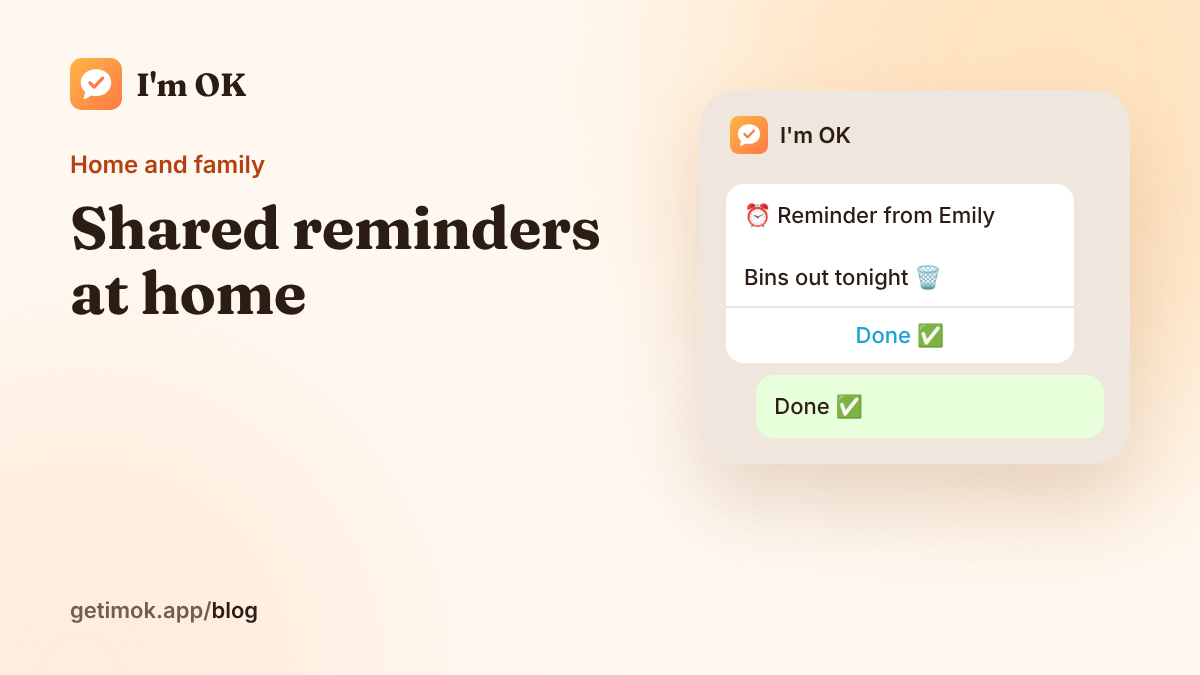
I'm OK sends reminders on WhatsApp to the people you share a home with, so there's nothing new to install. You set it up in one message, for example "remind Sam every Tuesday at 7pm to put the bins out". Sam gets one message asking if he's happy to receive it, taps Yes, and from then on the reminder arrives every Tuesday with a Done button.
When Sam taps Done, you can see it's done on your page. If he doesn't, you're told, so you can give him a shout before the lorry arrives. The reminder comes from I'm OK, not from you, which is the whole point.
It's free to start, for you and up to 2 people, which covers most couples and small flatshares. With Plus, you can remind up to 6 people and you get a message every time something is done.
If you'd like to compare the different ways of setting reminders on WhatsApp, see our guide to setting reminders on WhatsApp, for you and for someone else.
Couples: making it fair without keeping score
For couples, the aim isn't a perfect 50:50 spreadsheet. It's that both people feel the load is shared.
- Talk about the invisible jobs. Booking the dentist, remembering birthdays, ordering the birthday present. These count.
- Trade, don't tally. "I'll do all the bins if you do all the bills" is easier than tracking every week.
- Agree what "done" means. "Cleaned the kitchen" can mean very different things to different people.
- Keep date night on the list. It sounds unromantic to set a reminder for it. It's less romantic to forget it for three months.
Flatmates: rent, bills and the bins
Sharing with friends or strangers adds money to the mix, which raises the stakes.
- Rent and bills on fixed dates. A reminder on the 1st (or the day before rent is due) for everyone who transfers money avoids awkward messages.
- One person per bill. If one flatmate pays the energy bill and others transfer their share, a monthly reminder for the transfers keeps it fair.
- Chores on a rota. Rotate weekly jobs like bins and cleaning, and set reminders that follow the rota.
- Moving out. Shelter's advice is to take your name off all bills and give a final meter reading when you leave.
Check in once a month
Five minutes at the end of the month: is anyone doing more than they agreed? Has a job been forgotten twice? Is a reminder arriving at the wrong time? Adjust and carry on. The system only has to be good enough that nobody is quietly resentful.
Questions people ask
How do we share household chores fairly?
List the recurring jobs once, give each one an owner, and rotate the ones nobody likes. Balance by time rather than number of jobs, and check in monthly.
How can I stop nagging my partner about chores?
Let reminders do it. A reminder that arrives on its own at the right time, and shows when it's done, means you don't have to ask.
What's the best way to remind flatmates to pay rent?
A reminder for everyone on the same day each month, a day before rent is due. With I'm OK, each flatmate gets it on WhatsApp and taps Done when they've paid.
Is a group chat good for household reminders?
For quick questions, yes. For chores, not really: everyone assumes someone else will do it. Reminders to one named person work better.
Do my flatmates need to download an app?
Not with I'm OK. Reminders arrive in WhatsApp, and they just tap Done.
Keep reading
Caring for a parent from abroad
Living in a different country from your parents? Practical ways to stay involved, from a local support network and paperwork to daily signs that all is well.
What is a safety word, and how do you use one?
A safety word is a secret word that tells the people you trust you need help, without anyone else knowing. How it works, when to use one, and how to set one up.
How to remind someone without nagging
How to remind your partner, parent or teenager without sounding like a nag. What makes reminders feel like care rather than criticism, with examples.