Clocks go back on 25 October: a checklist for you and your parents
The clocks go back at 2am on Sunday 25 October. A short checklist for you and your parents, from clocks and medicines to smoke alarms and darker evenings.
On this page
The clocks go back one hour at 2am on Sunday 25 October 2026, according to GOV.UK. You get an extra hour in bed, and the evenings get dark much earlier from Monday.
Phones and laptops change by themselves. Plenty of other things don't, and the switch to dark evenings is a good moment to check a few things for yourself and for older parents.
Here's a short checklist. Most of it takes a few minutes, and a couple of items are worth doing on the Sunday itself.
Which clocks change by themselves?
Anything connected to the internet or the mobile network usually updates on its own: smartphones, laptops, smart speakers and most smart TVs.
These usually need changing by hand:
- The oven, microwave and hob
- The car clock
- Central heating and hot water timers
- Wall clocks, alarm clocks and watches
- Timers on lamps, plug sockets and outdoor lights
- Some older digital radios and video recorders
The heating timer is the one that catches people out. If it isn't changed, the heating comes on an hour early (or the hot water isn't ready when it should be) for months.
A checklist for your parents
If you're helping an older parent, the clock change is a good excuse for a quick check-in, in person or on a call. Go through it together rather than doing it for them.
| Task | Why it matters |
|---|---|
| Change the heating and hot water timers | So the house is warm when they get up, not an hour before |
| Change the oven, microwave and wall clocks | Mismatched clocks are confusing, especially first thing in the morning |
| Check the medicine routine | Tablets taken "with breakfast" won't change, but anything taken by the clock needs the right clock |
| Test the smoke alarms | A natural moment to press the test button on each one |
| Check outdoor lights and timers | Dark from about 5pm means paths and doorsteps need light earlier |
| Charge the torch and check spare bulbs | Power cuts are more likely in winter storms |
| Talk about evening plans | Fewer people want to walk home in the dark; lifts or earlier times may help |
Medicines and the clock change
For most tablets, an hour's shift makes no difference: your parent simply takes them at the usual time by the clock (breakfast is still breakfast). The most important thing is that the clocks they use are right, so a 9am dose doesn't quietly become 8am or 10am for months.
If your parent takes something where timing matters a lot, ask the pharmacist before the weekend how to handle the change. The NHS tips for carers suggest taking medicines at the right time of day and checking with a pharmacist when you're unsure. If tablets are sorted into a weekly organiser, nothing needs to change there.
For more on tablet routines, see our guide on how to remind an elderly parent to take their medication.
Test the smoke alarms
Changing the clocks means going round the house anyway, so press the test button on every smoke alarm as you go. The government's fire safety advice is to test smoke alarms regularly, and to have one on every level of the home.
If an alarm doesn't sound, replace the battery or the alarm straight away. Many fire services fit free alarms for older people; it's worth asking your local service if your parent needs one.
Darker evenings: small changes that help
From Monday it will be dark by around 5pm. A few things worth thinking about:
- Walking home. If you, a teenager or a parent usually walk home after dark, agree a quick "home safe" message. Our guide to living alone safely covers simple check-ins.
- Outdoor lighting. A motion-sensor light by the front door is cheap and makes a real difference to trips and falls on the doorstep.
- Routine shifts. Shorter days can mean people go out less. If a parent lives alone, a regular call or a daily check-in helps you notice if they're quieter than usual.
- Bins. Bin night in the dark is a common time for slips. A reminder earlier in the evening, while it's lighter, can help.
Do reminders still arrive on time?
Reminders on smartphones follow the phone's clock, which updates itself. Reminders set "at 9am" should still arrive at 9am local time after the change.
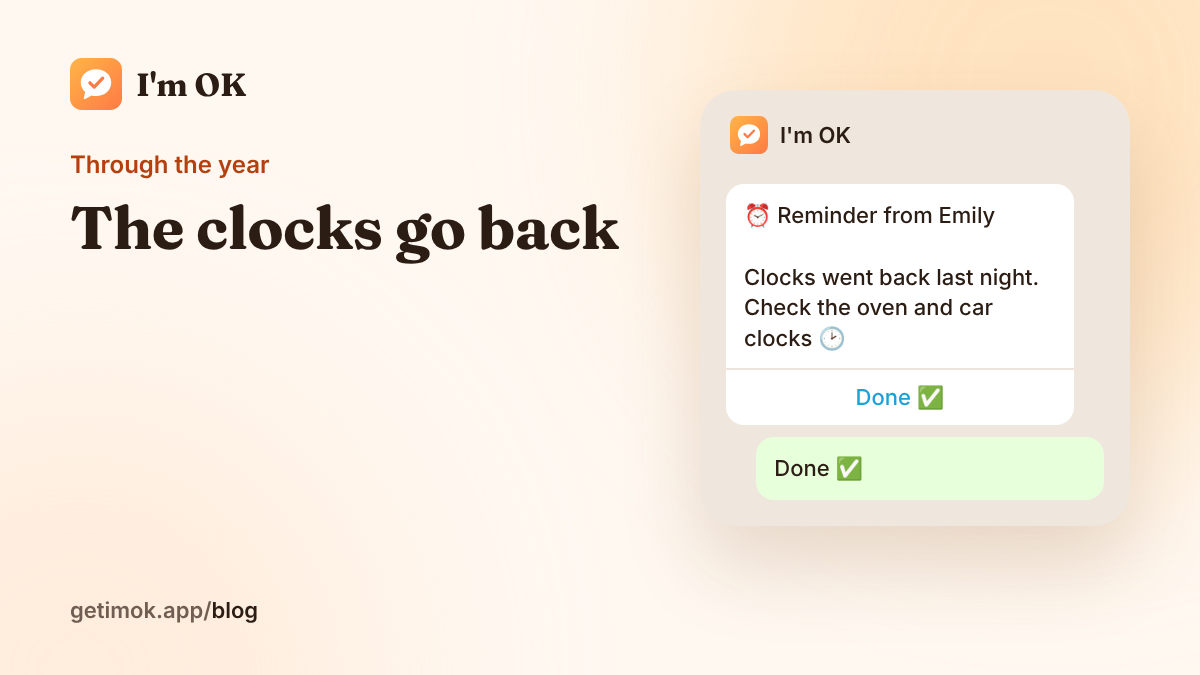
With I'm OK, reminders follow the local time of the person receiving them. Mum's 9am tablet reminder arrives at 9am her time on Monday, just as it did the week before, and the same goes for daily I'm OK check-ins. Nothing to change.
A one-off reminder works well for the clock change itself. For example: "remind Dad on Sunday at 10 to change the heating timer". He gets it on WhatsApp with a Done button, and you can see when it's done. If you'd like to make it a yearly habit, our guide to helping an ageing parent remember the important things has more ideas.
Questions people ask
When do the clocks go back in 2026?
At 2am on Sunday 25 October 2026, the clocks go back one hour to 1am. It's the end of British Summer Time and the start of Greenwich Mean Time.
Do I need to change my phone?
No. Smartphones update automatically as long as automatic date and time is switched on, which it is by default.
Should my parent take their tablets an hour earlier or later?
For most medicines, no: they carry on taking them at the usual clock time. If a medicine is time-critical, ask the pharmacist before the weekend.
What clocks do people forget to change?
The heating and hot water timer, the car, the oven and microwave, and timers on lamps or outdoor lights.
Will my reminders be an hour out?
Phone reminders and I'm OK reminders follow local time, so a 9am reminder still arrives at 9am after the change.
Keep reading
Caring for a parent from abroad
Living in a different country from your parents? Practical ways to stay involved, from a local support network and paperwork to daily signs that all is well.
What is a safety word, and how do you use one?
A safety word is a secret word that tells the people you trust you need help, without anyone else knowing. How it works, when to use one, and how to set one up.
How to remind someone without nagging
How to remind your partner, parent or teenager without sounding like a nag. What makes reminders feel like care rather than criticism, with examples.